Tag: technology

  • Enhancing Software Development with Generative AI

    Enhancing Software Development with Generative AI

    What is Generative AI

    Generative AI refers to artificial intelligence systems that can generate new content. This includes everything from code snippets to fully rendered images, and even synthetic media like videos and music. Chat GPT and Gemini AI are Large Language Models which widely known applications of Generative AI today.

    Generative AI Tools for Software Development

    Tools like GitHub Copilot is an example of how generative AI systems help in coding. It suggests entire lines or blocks of code as we type. It’s fascinating to see how deeply AI is integrated into the tools that we use daily. Think about search engines, recommendation systems, IDEs, and  even some debugging tools, all powered by AI to enhance our efficiency

    Generative AI is not just a tool for creating content faster. It shows a paradigm shift in how we can approach problems and solutions in software development. It offers a way to automate and enhance creativity, reducing the time from concept to product. Whether we are building enterprise applications or games, understanding generative AI will give us a significant edge. Let us see some of the features with examples on how Gen AI can help in software development

    Pair coding with LLM(ChatGPT)

    Lets ask ChatGPT to write a simple Python function that adds two numbers. Here’s how we can phrase the prompt to ensure clarity and specificity. 

    Can you write a python function to add two numbers named a and b and return the result? Below is the result from ChatGPT
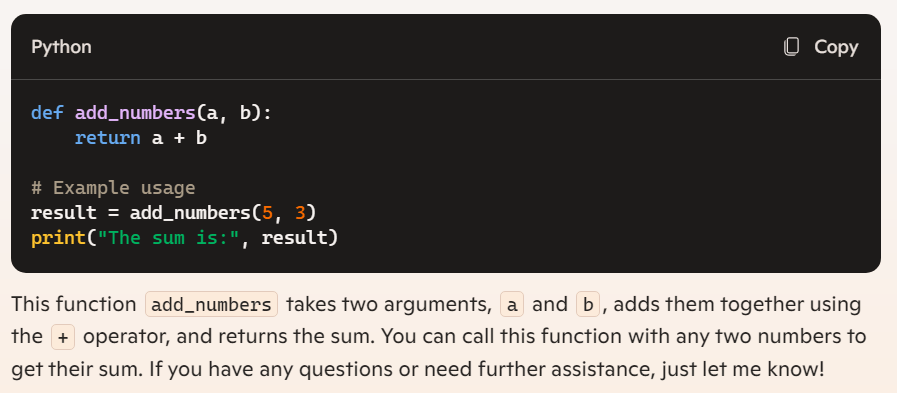
    We can ask ChatGPT to generate a function in Java Script or C# to do the same job. it shall generate code in those languages as well. but when we ask to generate code in C#, we should ask to generate a method. In C#, method is the correct term.

    Understanding the domain knowledge of the language, the APIs, and the supporting libraries makes us better developers. It will also make us a better prompter. Knowing the domain knowledge of the business problem is crucial. It will help us find better ways of expressing the solution. We can express it in either prompts or code. So our skills and knowledge are extremely valuable even in the age of prompt generated coding. 

    Domain Specific Prompting :

    By making our prompts more specific and detailed, specifying parameters and conditions helps the model to refine its output. 

    Let’s ask for a python function that uses NumPy to add two arrays. below is the result from ChatGPT
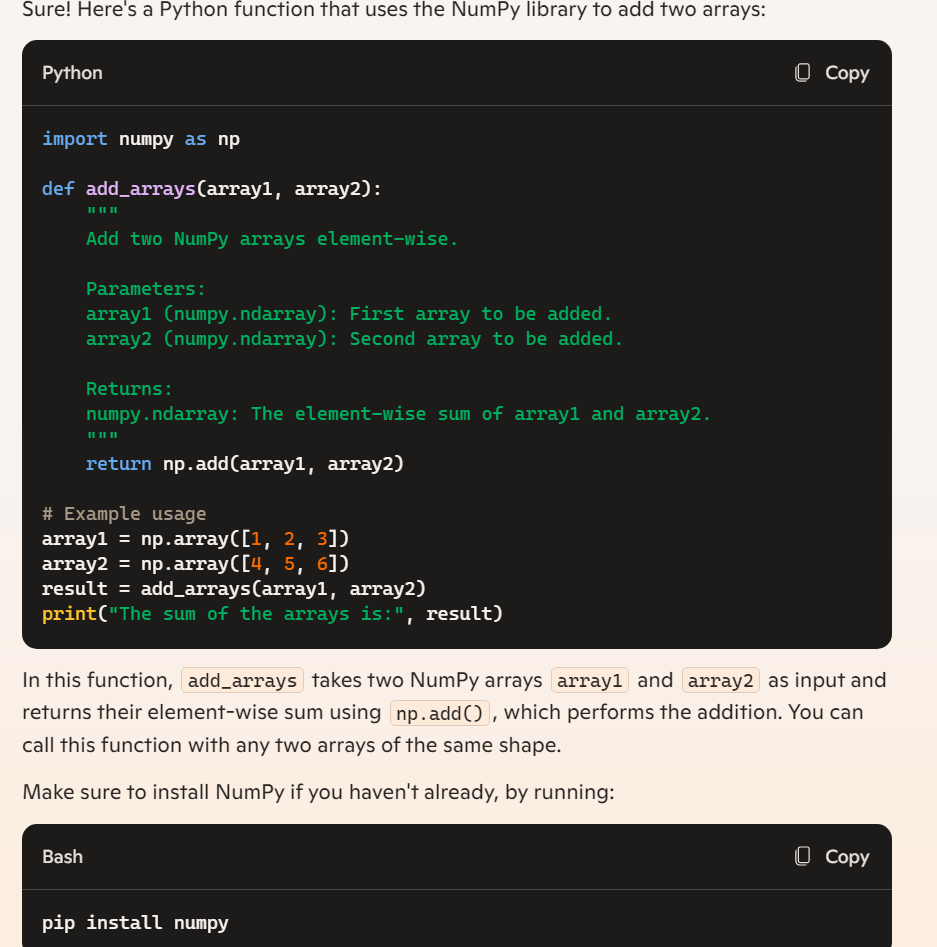
    We specified numpy by mentioning it. Chat GPT knows to include the appropriate import. It also knows to use the library’s functions. For example, here it’s using the np.add function to add the two arrays. First, it provides an example of how this function could be used. Then, it offers a quick explanation of the generated code. 

    Interactive coding with LLM

    And now let’s consider the concept of interactive coding to continuously update our code. It doesn’t have to be a one shot situation. We can take the code from GPT and then modify it. We can continue to prompt the model to create better code

    To improve a function iteratively by asking the model to write a basic JavaScript function. This function checks if a number is prime.

    Below is the result:
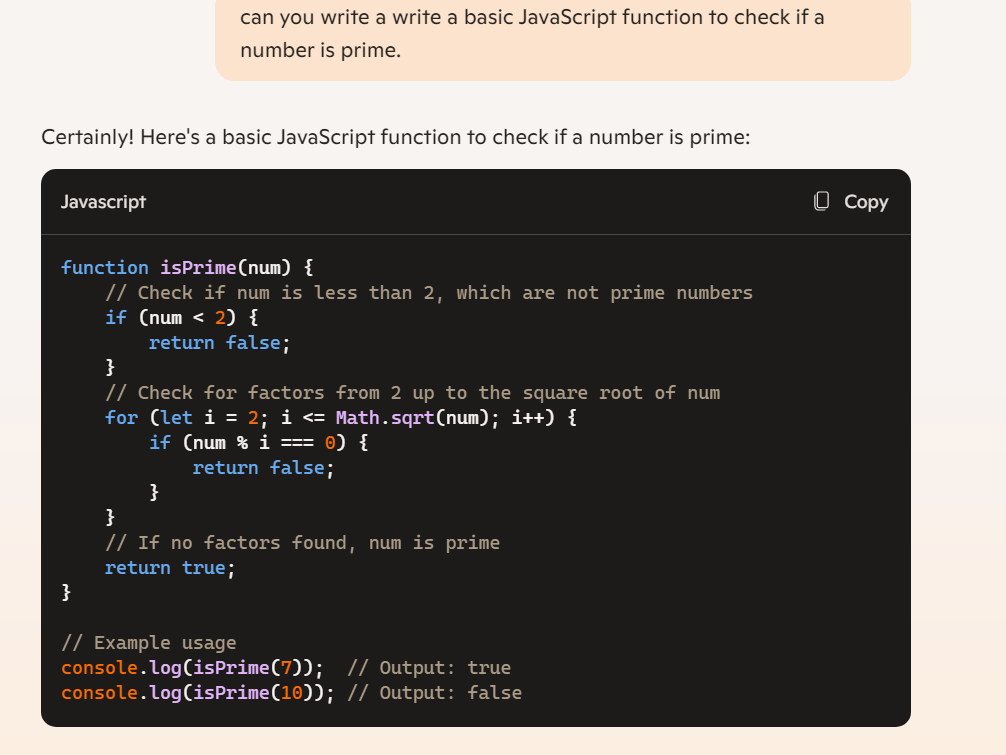
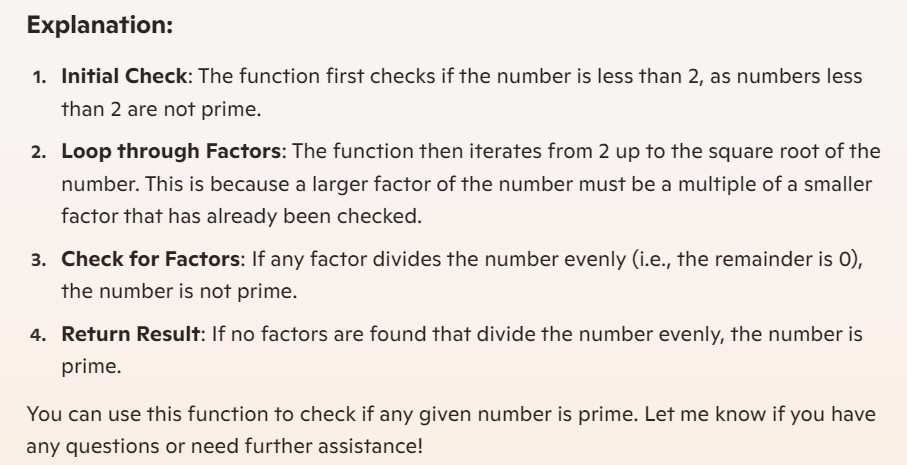
    The model responded with some code. It looks like first the function checks if the number is less than 2. Next, it checks a potential factor starting at two. It goes all the way up to the square root of the number. If it ever finds a factor it will return false, but otherwise it will return true. Now, while this isn’t the most efficient algorithm, it’ll definitely work. For now, though, we want to tackle a different problem, which is the lack of error handling. So lets ask the model to add some to make sure that the input is a positive integer.

    Below is the result:
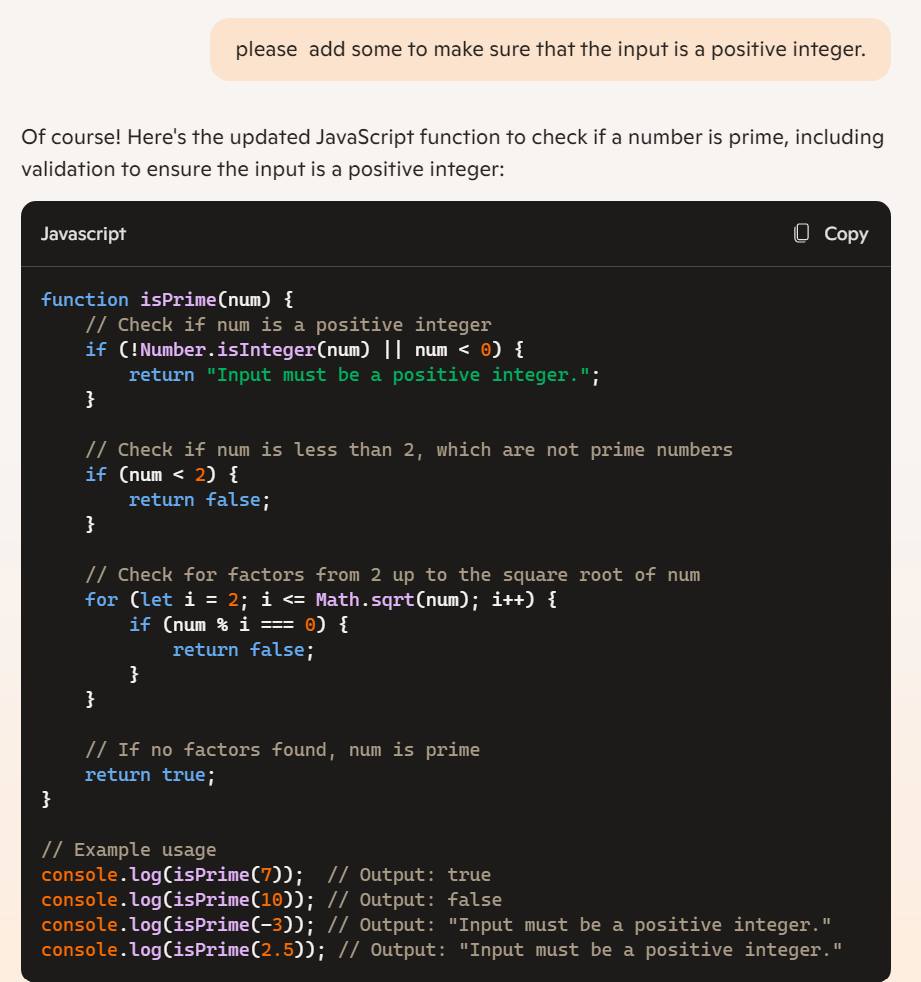
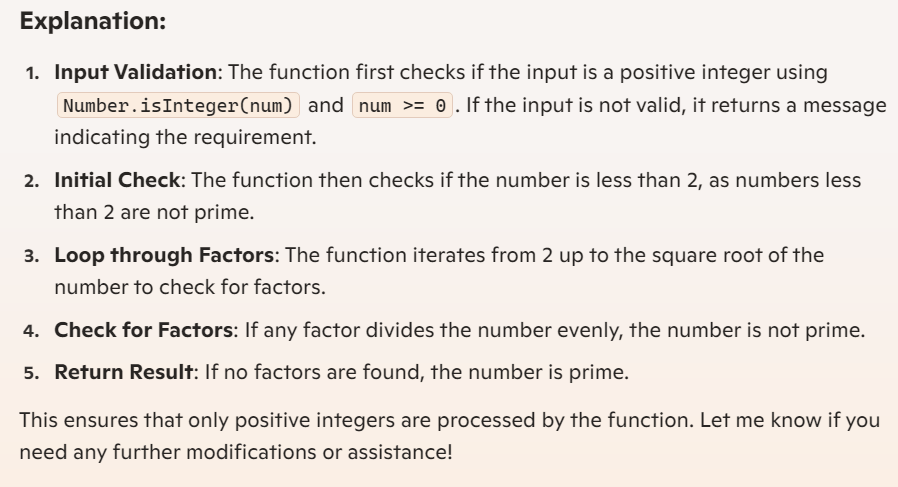
    so the model has updated its code to add that error handling in. 

    First it checks if the input is an integer, and then it checks that the input is positive. If either check fails, the new function will throw an error. Notice that the rest of the function is identical to what we had before. 

    Below that, the example usage code has been updated to use try and catch. This change is to test the error handling that was just added.
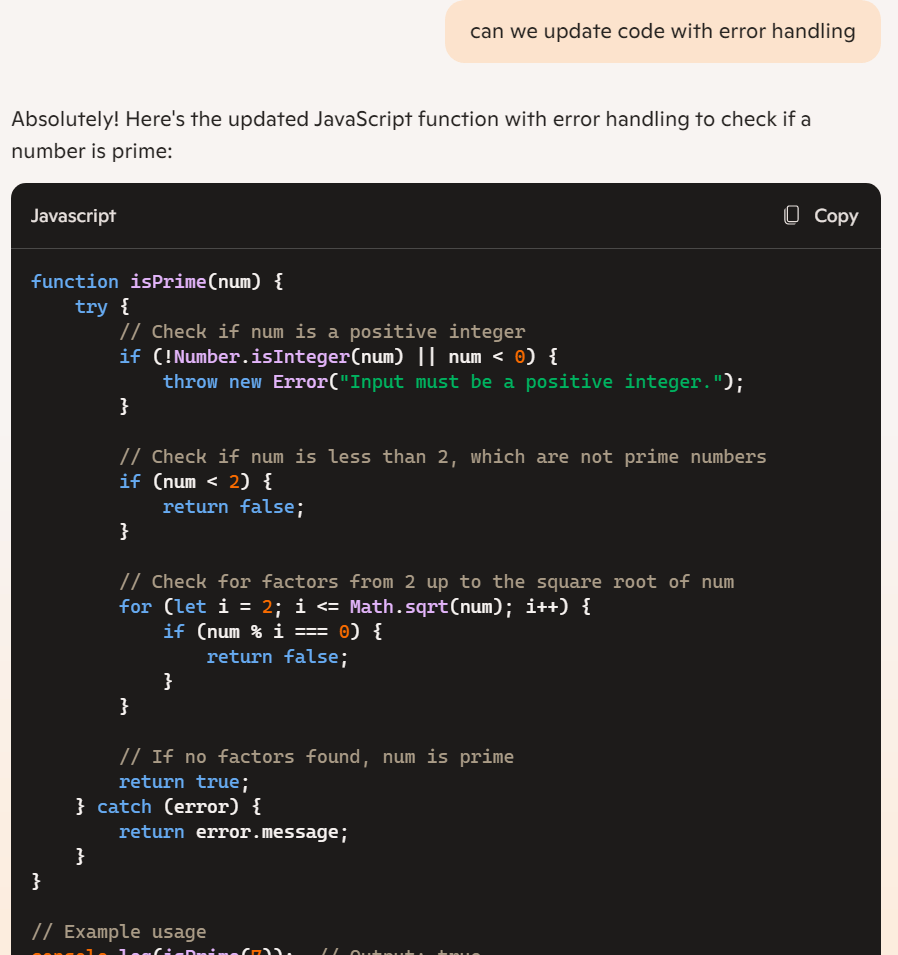
    This is pretty useful as well. 

    Conclusion

    In general, vague prompts can lead to ambiguous outputs. Just like a human colleague, the model requests more details. It does this if we don’t specify proper details of what it has to do.

    So when using prompts for code, or for anything really, but maybe especially for code, we should be specific. We have to use clear language. We must give as much context as necessary for the model to successfully finish the task.

    So these are the basic usages of Generative AI models in Software Development

    To be continued…

  • The Future of Quantum Technology: Challenges and Opportunities

    Quantum computing is an intriguing and rapidly evolving field with the potential to fundamentally transform technology as we know it. Classical computers use bits to represent data in binary states (0 or 1). In contrast, quantum computers use quantum bits, or qubits. These qubits leverage the principles of quantum mechanics, allowing them to exist in multiple states concurrently through superposition. This ability, merged with entanglement, enables quantum computers to execute certain calculations exponentially faster than their classical counterparts.

    Key Advancements and Innovations

    1. Enhanced Hardware The recent advancements in quantum hardware have been truly remarkable. Leading the charge is IBM with its development of the 1121-qubit ‘Condor’ processor. This processor marks a significant milestone in qubit fidelity and stability, essential for practical quantum computing. Researchers are also exploring a variety of qubit technologies. These include superconducting qubits, trapped ions, and topological qubits. Each type has its unique advantages and challenges.
    2. Quantum Algorithms The development of quantum algorithms is a critical area that continues to see exciting progress. These algorithms are designed to leverage the unique capabilities of quantum processors. They open up new possibilities for solving complex problems. These problems are now beyond the reach of classical computers. Notable quantum algorithms include Shor’s algorithm for factoring large numbers and Grover’s algorithm for searching unsorted databases more efficiently.
    3. Quantum-Safe Cryptography As quantum computing advances, traditional encryption techniques face threats. Quantum algorithms like Shor’s algorithm can efficiently break many classical cryptographic schemes. In response, the industry is developing quantum-resistant cryptographic solutions to ensure data security in a post-quantum world. These new techniques aim to be robust against both classical and quantum attacks, providing a future-proof security framework.
    4. AI Integration Quantum computing integration with artificial intelligence (AI) is fostering groundbreaking advancements. These advancements span various domains. They include machine learning, healthcare, and material science. Quantum machine learning algorithms can analyze vast datasets more efficiently. They uncover patterns and insights that were once hidden. This synergy between quantum computing and AI promises to accelerate innovation and solve some of the world’s most pressing challenges.

    Future Applications

    1. Chemistry and Materials Science Quantum computing can simulate complex chemical reactions and interactions. It achieves this at an unprecedented level of detail. This capability can significantly accelerate the discovery of new materials and drugs. It leads to advancements in pharmaceuticals, energy storage, and more. By providing deeper insights into molecular behavior, quantum computers can revolutionize fields that rely on precise chemical modeling.
    2. Optimization and Machine Learning Quantum computing holds great potential for solving optimization problems in various industries. For example, logistics and supply chain management can benefit from quantum algorithms that optimize routing and resource allocation. In machine learning, quantum computers can enhance data analysis and pattern recognition, leading to more accurate and efficient models. These advancements can drive innovation in areas ranging from financial modeling to autonomous systems
    3. Hybrid Systems Fully quantum solutions are still on the horizon. Many practical applications will require a combination of classical and quantum computing. This approach will achieve the best results. Hybrid systems integrate classical processors with quantum coprocessors to handle complex tasks more efficiently. They leverage the strengths of both computing paradigms. This approach can provide near-term benefits while the field continues to evolve.

    Challenges and Considerations

    1. Scalability One of the primary challenges in quantum computing is scaling quantum systems while maintaining qubit coherence and minimizing errors. As the number of qubits increases, so does the complexity of managing their interactions. Researchers are developing advanced techniques to address these challenges, aiming to build larger and more reliable quantum processors.
    2. Error Correction Robust error correction is essential for practical quantum computing. Qubits are susceptible to various types of errors due to their delicate nature. Developing effective error correction codes and fault-tolerant quantum algorithms is a critical area of research. These solutions will ensure that quantum computations can be performed accurately and reliably
    3. Security Concerns As with any new technology, quantum computing presents unique security challenges. Ensuring the security of quantum computing systems and developing quantum-safe encryption methods are ongoing priorities. Organizations must be proactive in addressing these concerns to fully harness the potential of quantum computing while safeguarding sensitive information.

    Conclusion

    The future of quantum computing is brimming with exciting possibilities and significant advancements. Quantum computing is set to redefine the technological landscape. This ranges from enhanced hardware to groundbreaking applications in chemistry. It also includes optimization and AI integration. As the field continues to mature, it will tackle complex challenges. It will open new avenues for innovation. This will drive progress in ways we can only begin to imagine.

    By staying at the forefront of quantum research and development, businesses and researchers can unlock unprecedented opportunities. They can also usher in a new era of computational power and efficiency. The journey of quantum computing is just beginning, and its impact on our world will be profound and far-reaching.